#1 Marketing funnel model
A Marketing Funnel is a tool that helps you map the customer journey, or the process a potential customer goes through to learn about your company, product or service, from introduction to conversion into a customer (and can go even further – evangelism).
To attract potential customers (leads) and turn them into customers is a process. Typically, people who visit your store go through a few steps on the way to becoming a truly valuable customer. This set of activities is called the “Marketing funnel”. Your job is to follow up with potential customers, gradually bringing them closer to purchasing your goods/services. Building an effective marketing funnel can make a huge difference to other marketing campaigns, and here are some things you should know about the process.
This marketing model is like building a customer journey map. How to go from potential customers, searching for products, starting to interact with the sales process, accessing media messages, becoming customers, loyal customers and then becoming product evangelists.
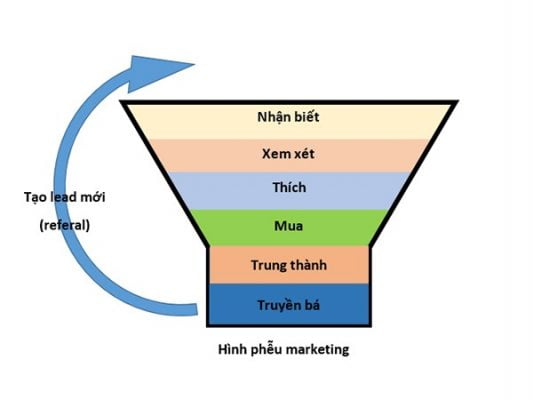
Below is a 5-step marketing funnel model you can refer to:
Step 1: Identify the product
This is the first stage in the model. At this time, the target audience does not have any awareness about the product. The task of marketers is to make customers aware of the presence of products/services through media, advertising… Research where your target audience usually “lives” in reality and on the internet, to flexibly use appropriate marketing solutions.
Step 2: Review
After identifying the product, customers will review and compare it with other similar or alternative products on the market in terms of price, function, quality, design, warranty… At this time, marketers need to have solutions to highlight their products/services compared to competitors.
Step 3: Like
At this point, customers are impressed and interested in your product and begin to want to own it. But don't be subjective, a sales process can still fail even if the customer likes the product. Related factors such as staff service attitude, installation mode and instructions for use, warranty, after-sales… have a great influence on the next step in the marketing funnel model.
Step 4: Purchase
When all relevant requirements have been satisfied, the customer will make a purchasing decision. Let's create conditions for everything to be as convenient for customers as possible, to enter step 5 of this marketing funnel cycle.
Step 5: Loyalty
Every business wants to build a team of brand-loyal customers. The task of marketers is to develop strategies for after-sale customer care, after-sales service, creating close relationships, visiting customers… so that they are loyal to their brand.
The cost to find a new customer is 5 times higher than the cost to keep an old customer, so comprehensive customer care will bring unexpected benefits to businesses. Both in terms of revenue and brand reputation.
Step 6: Spread the word
Customers are the best sellers for businesses. The incredible influence of word of mouth has been proven in businesses' marketing campaigns.
A referred customer will have a much higher closing rate than a new customer, but the cost is many times smaller. Therefore, focusing on satisfying customer needs and taking care of them comprehensively will help businesses successfully implement the marketing funnel model, taking potential customers through each step of the model to the final stage.
#2 MODERN DIGITAL MARKETING FUNNEL
STAGES IN THE DIGITAL MARKETING FUNNEL FROM THE FIRST TO THE END OF THE FUNNEL (OR MORE EXACTLY, FROM THE TIME THE USER BEGINS AWARENESS TO THE TIME THEY BECOME A LOYAL CUSTOMERH)
Digital Marketing Funnel is defined quite generally. But you can simply understand it as a framework to help identify, understand and follow the different journey stages that buyers go through in the customer lifecycle. The “AIDA” Marketing Funnel is being widely used in most communication campaigns, however it is only a one-way funnel that basically describes a customer's journey in the simplest way as shown below:
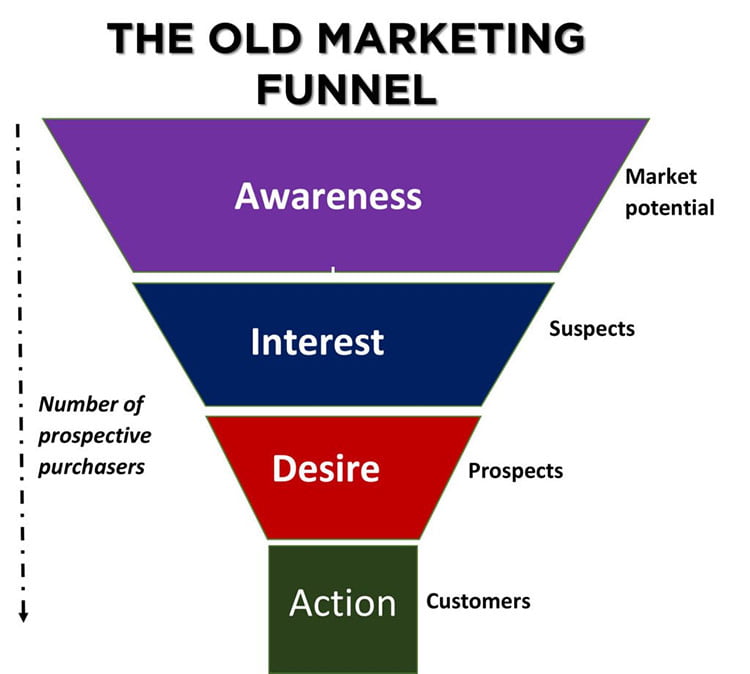

The stages in the new marketing funnel are similar to the old marketing funnel (AIDA) and it includes:
Awareness (Awareness)
Consider (Consideration) – along with the Research & Discovery Loop
Purchase (Purchase)
Post-purchase experience (Post-Purchase Experience) – customer loyalty loop (Loyalty Loop)
Digital Marketing top 1 will break down each stage with the following practical examples. Suppose the buyer is Ms. Nguyen Thi A, a 35-year-old homeowner with 2 young children
See more: Aida model in Marketing
#EXAMPLE 1: Mrs. A needs to buy a new air conditioner for her small family
First, Mrs. A noticed that the air conditioner in the house was starting to deteriorate, which was shown by the temperature in the room gradually warming up. She checked her air conditioner pipes and realized the air conditioner might be broken – Awareness
- After that, Ms. A searched on Google for “air conditioner temperature failure” – Consideration.
- Ms. A read blog/forum articles about repair issues and had to replace her air conditioner because it was too old – Awareness
- Ms. A continues to search on Google “How much does an air conditioner cost” and she looks at the types of air conditioners on company A's website – Consideration.
- Mrs. A overheard that her neighbor was also planning to replace the air conditioner and accidentally heard the suggestion to “buy from company B” – Awareness.
- Ms. A continues to provide her criteria on Google Search and compares and evaluates companies A and B in terms of service quality, after-sales policy, and price – Consideration.
- Mrs. A narrows down her options by asking for opinions and recommendations from friends or neighbors who have used company B's products – Consideration.
- Mrs. A saw an ad at the top of Google for one of the companies her friends and neighbors had previously recommended – Consideration.
- Ms. A accesses the website and chats with the support mailbox to receive advice – Purchase.
Then her new air conditioner was installed. She starts telling her friends how satisfied she is with the quality of company XXX or Ms. A goes to support users who are also leaving comments on Google by replying to them – Loyalty loop (Loyalty loop)
Mrs. A's family began to notice that the air conditioner was not working effectively. Mrs. A saw a blog on Facebook about how dirty air conditioners and depleted “gas” can affect performance . When she saw a discount from the company for air conditioner cleaning and gas refilling in an email newsletter, she clicked on special and performed the air conditioner cleaning – Loyalty loop (Loyalty loop).
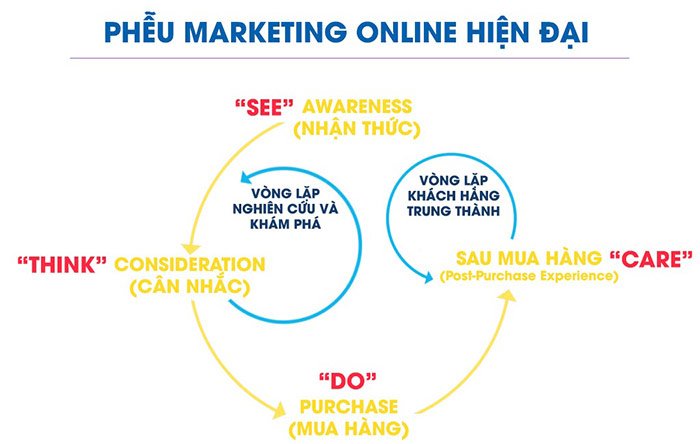
SEE-THINK-DO-CARE MODEL IN THE NEW MARKETING FUNNEL
The See-Think-Do-Care model is based on consumer intent and divides each stage into different audience clusters:
See: Quality object but no purchase purpose
Think: Quality audience with a small number of purchasing goals
Do: quality audience with a multitude of purchasing intentions
Care: Existing customers have made 2 or more purchases
We can easily incorporate this model into a modern marketing funnel as shown below
At this stage, the “audience” is still unfamiliar with the brand and your task is to find their interests and thereby create attractive content to reach them in the most friendly way. Therefore, the goal in this stage is to create content that customers really need and care about, not articles that increase sales or focus on products. The two best options for this stage are Social Media & Display Ads
Ways to do it for you:
- Create viral videos on social: When they feel a video about a piece of knowledge is useful or fun, they will share and comment a lot. In particular, if the video catches the trend, the amount of interaction as well as the possibility of going viral will certainly be very high, from which the brand can reach a wider audience of target customers.
- Create useful content articles according to each customer's interest on the Website and optimize SEO on Google: This helps increase trust in businesses every time customers look for solutions to their problems and increases customer interaction with the business website.
- Use gift tricks: You can ask customers to comment, inbox with share when sharing interesting information about your brand. If customers comment, you can run retargeting to reach that audience in the next step. If customers inbox, you can use chatbot to send them free messages in the next step.
- Use free moves: Invite customers to experience any service for free by leaving your phone number/email according to the instructions.
With social networks, thanks to the flexibility in choosing content formats: from regular articles, eye-catching images, videos, .. to GIFs – whatever you find your customers will be most attracted to?

Author
BIÊN TẬP VIÊN FHC