According to IDC's 2018 survey, digital transformation is becoming a strategy for businesses and organizations in the fourth industrial revolution. Nearly 90% of businesses have started digital transformation with different steps from learning, researching, to starting to deploy and implement. More than 30% of surveyed business leaders view digital transformation as a matter of survival, confirming its effectiveness in many aspects such as understanding customers, increasing labor productivity, accelerating creativity…
What is digital transformation?
There are many definitions and understandings of digital transformation. According to Gartner, digital transformation is the use of digital technologies to change business models, creating new opportunities, revenue and value. Microsoft believes that digital transformation is about rethinking how organizations bring together people, data and processes to create new value.
From FPT's perspective, digital transformation in organizations and businesses is the process of changing from a traditional model to a digital business by applying new technologies such as big data (Big Data), Internet of Things (IoT), cloud computing (Cloud)… changing operating methods, leadership, work processes, and company culture. Digital transformation brings many benefits such as cutting operating costs, reaching more customers over a longer period of time, and leaders making faster and more accurate decisions thanks to a timely and transparent reporting system. Thereby, the operational efficiency and competitiveness of organizations and businesses are enhanced.
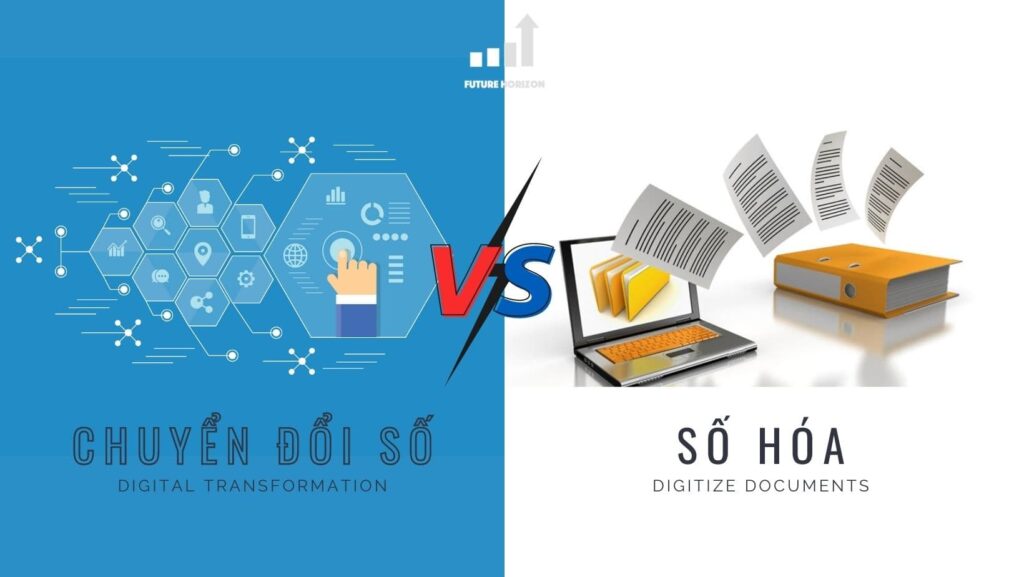
So how is digital transformation different from digitization?
During the Digital Transformation – Opportunities and Challenges conference held in November 2018 in Hanoi, Mr. Nguyen Thanh Phuc, Director of the Department of Information Technology – Ministry of Information and Communications, explained that “digitization” is the transformation of real values into digital form, and “digital transformation” is that when data is digitized, we must use technologies such as AI, Big Data… to analyze data, transform it and create another value.
We can take Grab as an example in building a ride-hailing application. What the user sees on the phone screen is simply a cycle of booking a car and completing the trip for the passenger and driver, but hidden deep is a complex system. The company must analyze large amounts of data related to drivers' driving habits, user needs, route creation features, real-time navigation… From the car booking service, the company has expanded to many other products such as delivery, food purchasing…
Why digital transformation?
At the “Global Digital Transformation” conference at the end of April in Ha Long, Mr. Truong Gia Binh, Chairman of FPT, affirmed: “The question that businesses must ask remains the same: how to grow, to have customers, to be profitable, but the answer is very different and digital transformation companies will show superiority. In other words, without digital transformation, the competitiveness of businesses will lose in rank and sooner or later have to leave.”
Meanwhile, sharing at the Digital Enterprise conference from practice to awareness on April 11 in Hanoi, Mr. Phi Anh Tuan, Vice President of Ho Chi Minh City Information Technology Association, affirmed that “business digital transformation is an irreversible trend, in which data will become the biggest asset of businesses because data useful for businesses is increasingly diverse and the cost of collecting data useful for businesses is rapidly decreasing.”
Sharing the same opinion, Professor Ho Tu Bao, from the Institute for Advanced Study in Mathematics (VIASM), said that businesses, large or small, cannot say “no” to digital transformation: “Digital transformation is an inevitable path, businesses need to clearly understand and have a specific strategy to pursue, and have the right investment in important digital transformation tools such as AI, data science, business analysis…
According to Microsoft's 2017 research in the Asia-Pacific region, the impact that digital transformation will have on GDP in 2017 is about 6%, in 2019 it is predicted to be 25% and by 2021 it is 60%. Digital transformation also increased labor productivity by 15% in 2017, expected to be 21% in 2020; 85% of jobs in the region will be transformed in the next three years.
Research company McKensey points out that, by 2025, the impact of digital transformation on GDP in the US will be about 25%, while in European countries it will be about 36%.
What to do to convert numbers?
Mr. Phuong Tram, Chief Digital Transformation Consultant of FPT, said that digital transformation is the development of employees, leadership and changing the business to become faster, cheaper and better in a breakthrough path. All businesses will be digital businesses in the future. Technology, business processes and community experience sharing will go hand in hand.
“There are three things that need to be done. The first is leadership readiness. Leaders need to understand what they want and how technology can transform their company. Second is organizational readiness. It takes the whole organization's participation to make the transformation happen. We need to train and develop personnel. Third is technological readiness. This needs to be developed in parallel with human resources factors,” Mr. Tram emphasized.
According to him, digital transformation “means applying technology to transform daily business practices. Simply put, it's the way we apply technology along with business operations to do things differently, to do business more efficiently, faster, and transform it in one day when it used to take three months, or just using a few dozen people rather than thousands. Instead of doing routine work, the company can do higher value work. The company doesn't grow doing normal jobs.”
How does digital transformation take place in Vietnam?
In Vietnam, the digital transformation process has begun to take place, especially in industries such as finance, transportation, tourism… The Government and authorities at all levels are making efforts to build e-Government towards a digital Government. More than 30 cities also plan to build Smart Cities with new technology platforms… FPT said it is also implementing digital transformation for FPT itself with nearly 36,000 people and is committed to achieving results within the next 12 months.
However, Vietnamese businesses in general, especially small and medium enterprises, are still not properly aware of the role of digital transformation in the fourth industrial network. Specifically, according to VCCI, Vietnam's small and medium enterprises currently account for about 97% of the total number of businesses, the level of science, technology and innovation is still low, 80% to 90% of machinery used in Vietnamese businesses are imported, nearly 80% are old technologies from the 1980s-1990s.
In April, Cisco published the report “Digital Development Index of Small and Medium Enterprises in the Asia-Pacific Region”, conducted on 1,340 businesses in the region in general and 50 Vietnamese businesses in particular. In Vietnam, small and medium-sized enterprises are facing barriers in the digital transformation process such as lack of digital skills and human resources (17%), lack of a strong enough information technology platform to enable digital transformation (16.7%), lack of digital thinking or digital culture challenges in businesses (15.7%),…
However, the report also shows that Vietnamese small and medium enterprises are initially investing in cloud technology (18%), network security (12.7%), and upgrading software and hardware for digital transformation (10.7%).
Tags:
digital transformation

Author
Future Horizon
Mục tiêu thành lập và xây dựng với sứ mệnh mang lại những công cụ và giải pháp kỹ thuật số (công cụ bán hàng online) tốt nhất cho các cửa hàng, doanh nghiệp nhỏ, hay đơn giản là những người mong muốn đạt được thành tựu trên không gian mạng nhưng cần sự giúp đỡ.